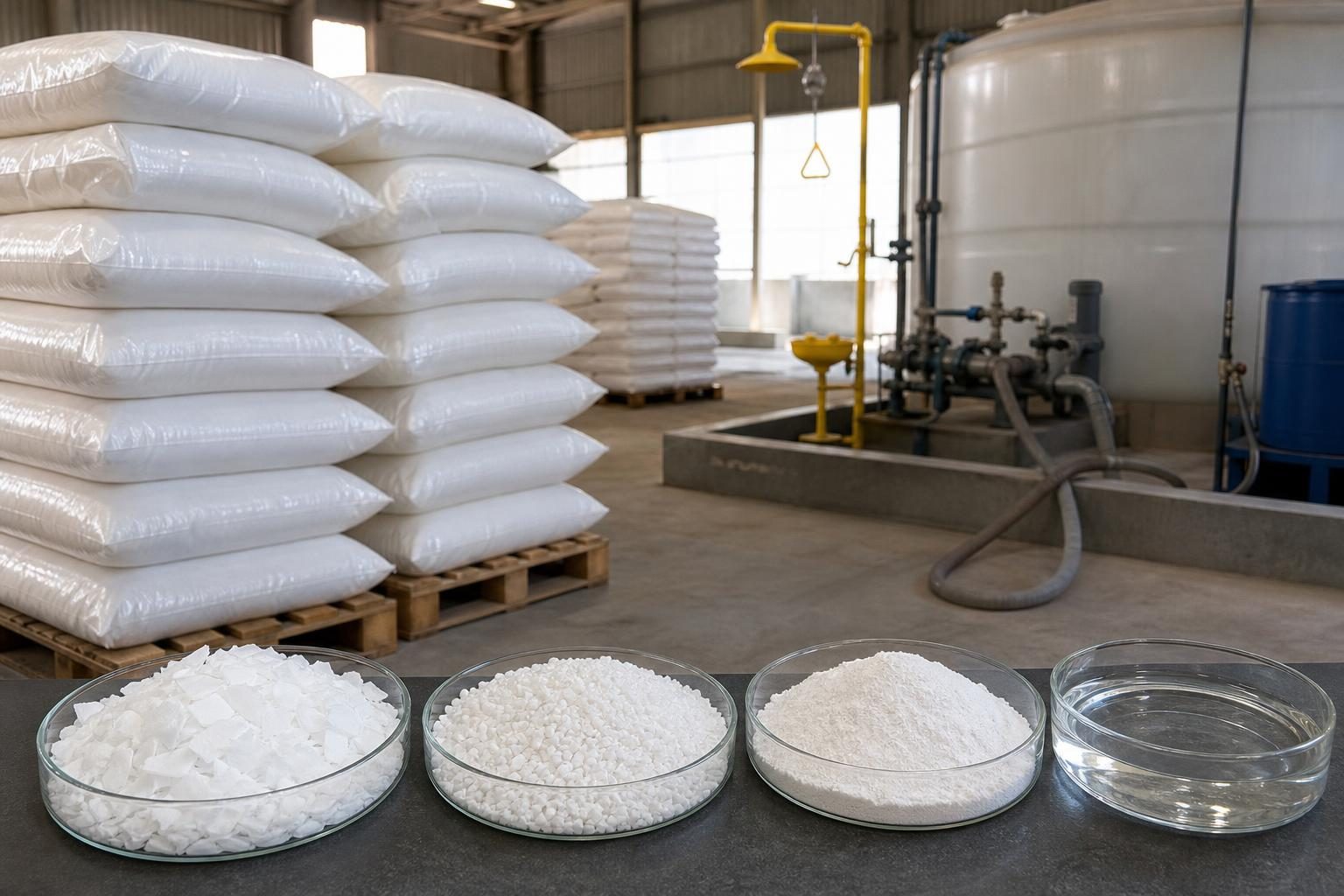
Calcium chloride buyers often know the required chemical name but not the best physical form. Flakes, granules, powder and liquid solution can all deliver CaCl2, but they behave differently in bags, hoppers, dissolving tanks and trucks. The practical question is not only “what percentage CaCl2?” but also “how will our team receive, store, dose and dissolve it?”
This guide separates general industry information from lot-specific data. For any purchase, request the supplier’s specification, certificate of analysis, safety data sheet and, where necessary, a sample from the specific lot offered.
What changes between solid and liquid calcium chloride?
ASTM D98 covers technical-grade calcium chloride used for applications such as dust control, road stabilization, ice and snow removal, concrete set acceleration and desiccant use. It recognises solid calcium chloride as flake, pellet or granular material, and liquid calcium chloride as water solutions at different concentrations. The standard also expects concentration to be expressed as a percentage of the total product.
That last point matters commercially. One metric ton of 94% solid calcium chloride contains far more active CaCl2 than one metric ton of 32% solution. For landed-cost comparison, calculate the cost per ton of active CaCl2, not only the invoice price per gross ton.
Calcium chloride is highly soluble, hygroscopic and deliquescent. In plain purchasing language, solid material can absorb moisture from air and may eventually form brine if exposed. A 2024 USDA technical report also notes that dissolving calcium chloride in water is strongly exothermic and can quickly raise solution temperature to about 60°C. This is useful in some applications but requires safe mixing practice.
How the main forms compare
| Form | Typical buyer reason to choose it | Main check before purchase |
|---|---|---|
| Flakes | Common solid form for making solution, deicing, dust control and general industrial use where fast wetting is useful. | Assay, moisture, caking condition, bag sealing and whether the form is suitable for the dosing equipment. |
| Granules or pellets | Useful when a more regular particle shape is preferred for flow, spreading or controlled feeding. | Particle size distribution, fines level, assay and whether the product is free-flowing on arrival. |
| Powder | May dissolve quickly and suit certain blending operations, but can be dustier and more sensitive to moisture pickup. | PSD, dust control, anti-caking status if any, packaging integrity and workplace exposure controls. |
| Liquid solution | Avoids on-site dissolution and is convenient where tanks, pumps and metered dosing are already available. | CaCl2 concentration by weight, density, crystallization/freezing behaviour, tank compatibility and delivered volume. |
Commercial examples show why the grade description must be explicit. OxyChem describes one flake product as 83–87% calcium chloride, an anhydrous mini-pellet product as 94–97%, and a technical liquid solution range as 28–42% by weight. These are manufacturer product examples, not universal specifications. Your enquiry should state the required assay range and whether substitutes are acceptable.
Choosing by handling and dissolution
If you make your own solution
Solid calcium chloride can reduce the amount of water shipped, but it transfers the dissolution step to the buyer. You need a suitable tank, water supply, mixing procedure, heat management and trained operators. Because dissolution releases heat, add calcium chloride to water gradually with agitation; do not assume that a small tank can accept a full jumbo bag quickly without temperature rise or splashing risk.
Flakes and granules are often easier for industrial teams to handle than very fine powder because they generate less dust and may bridge less in some systems. Powder can dissolve rapidly, but it should be selected only when the plant has dust collection, controlled charging and moisture-protected storage. If powder is offered, ask for a particle size distribution and handling guidance.
If you want direct dosing
Liquid calcium chloride is usually the better option when the site has bulk tanks, pumps and dosing lines. It avoids solid bag cutting, dust and mixing heat at the receiving site. The trade-off is freight: a 32% solution contains about 68% water by weight. A stronger solution may reduce freight per unit of active CaCl2, but higher concentration can have different freezing or crystallization characteristics that must match the climate and storage temperature.
For buyers in the UAE, GCC or India, ambient heat is usually not the same problem as winter freezing, but outdoor tank exposure, evaporation control, material compatibility and pump selection still matter. Request the SDS and technical data for the exact solution concentration offered.
What to put in the commercial enquiry
A precise RFQ avoids vague replies such as “calcium chloride available.” Include the following:
- Form: flake, granule, pellet, powder or liquid solution.
- Assay: required CaCl2 percentage by weight, and whether this is on as-is basis or active basis.
- Application: for example brine preparation, dust control, industrial process, desiccant use, concrete-related use or another purpose.
- Standard or grade: state ASTM D98, AASHTO M144, food-grade requirement, or your own in-house specification where applicable.
- Impurity limits: sodium chloride, magnesium salts, alkalinity, insolubles, iron or heavy metals if relevant to your process.
- Physical requirements: particle size, fines, powder dust level, free-flowing condition, colour and caking tolerance.
- Packing: small bags, palletized bags, jumbo bags, drums, IBCs or bulk tanker, depending on the form.
- Documents: specification sheet, COA, SDS, packing list and sample requirement.
If you are comparing calcium chloride with other industrial minerals or chemical raw materials, keep each RFQ separate and use a consistent checklist. Kasbonex also publishes procurement guidance for raw materials and bulk mineral deliveries in jumbo bags, which can help buyers organise packaging and logistics questions.
Packaging, storage and logistics considerations
Solid calcium chloride should be protected from atmospheric moisture. OxyChem’s SDS for 83–87% granulated calcium chloride describes the material as hygroscopic and deliquescent, recommends dry storage, tightly closed containers and resealing opened packages, and notes that outdoor storage should be protected with waterproof covers. These points are general handling principles, but packaging performance still depends on the supplier, liner, pallet protection and local storage conditions.
For solid cargo, inspect for torn bags, wet pallets, hardened lumps and evidence of brine leakage. Caked material may still contain calcium chloride, but it may not feed properly through hoppers, spreaders or dissolving systems. If free-flowing condition is critical, state this in the purchase order and define the inspection method.
For liquid cargo, specify concentration by weight, density or specific gravity at a stated temperature, packaging type and discharge method. Ask whether the tank, pump, hoses and seals at your site are compatible with the solution. Do not rely on appearance alone; calcium chloride solution is commonly clear and odourless, so laboratory concentration testing or supplier COA is important.
Frequently Asked Questions
Is 94–97% calcium chloride always better than flakes?
No. Higher assay means more active CaCl2 per ton, but flakes may be preferred for handling, dissolution behaviour, equipment compatibility or price per active ton. Compare total landed cost, not only assay.
When should a buyer choose liquid calcium chloride?
Choose liquid when the site wants metered dosing without dissolving solids, and when tanks, pumps and safe unloading arrangements are available. Always specify the required concentration by weight.
Is calcium chloride powder suitable for bulk handling?
It can be suitable for some blending or rapid dissolution needs, but it can create more dust and moisture-control issues than coarser forms. Ask for PSD, SDS and a sample before approving powder for plant use.
What documents should be requested with an order?
Request the product specification, COA for the supplied lot, SDS, packing details and any applicable standard declaration. For sensitive applications, request a pre-shipment or arrival sample.
References
- ASTM D98-15(2021), Standard Specification for Calcium Chloride
- New York State Department of Transportation, Section 712-02 Calcium Chloride
- USDA Agricultural Marketing Service, 2024 Technical Report: Calcium Chloride Handling
- OxyChem SDS, Calcium Chloride 83–87% Granulated
- OxyChem DOWFLAKE Xtra 83–87% Calcium Chloride Flakes
- OxyChem Anhydrous Calcium Chloride 94–97% Mini-Pellets
- OxyChem LIQUIDOW Technical Grade Calcium Chloride Solution Sales Specification
Request calcium chloride specifications and a quotation
To prepare a clear enquiry for calcium chloride flakes, granules, powder or solution, send your required form, assay, packing, destination and application details to sales@kasbonexglobal.com. You can also request technical specifications, a supply-availability check and a quotation through the form at kasbonexglobal.com. Kasbonex can provide information for the specific lot offered; no price, stock position or delivery date is implied until confirmed.