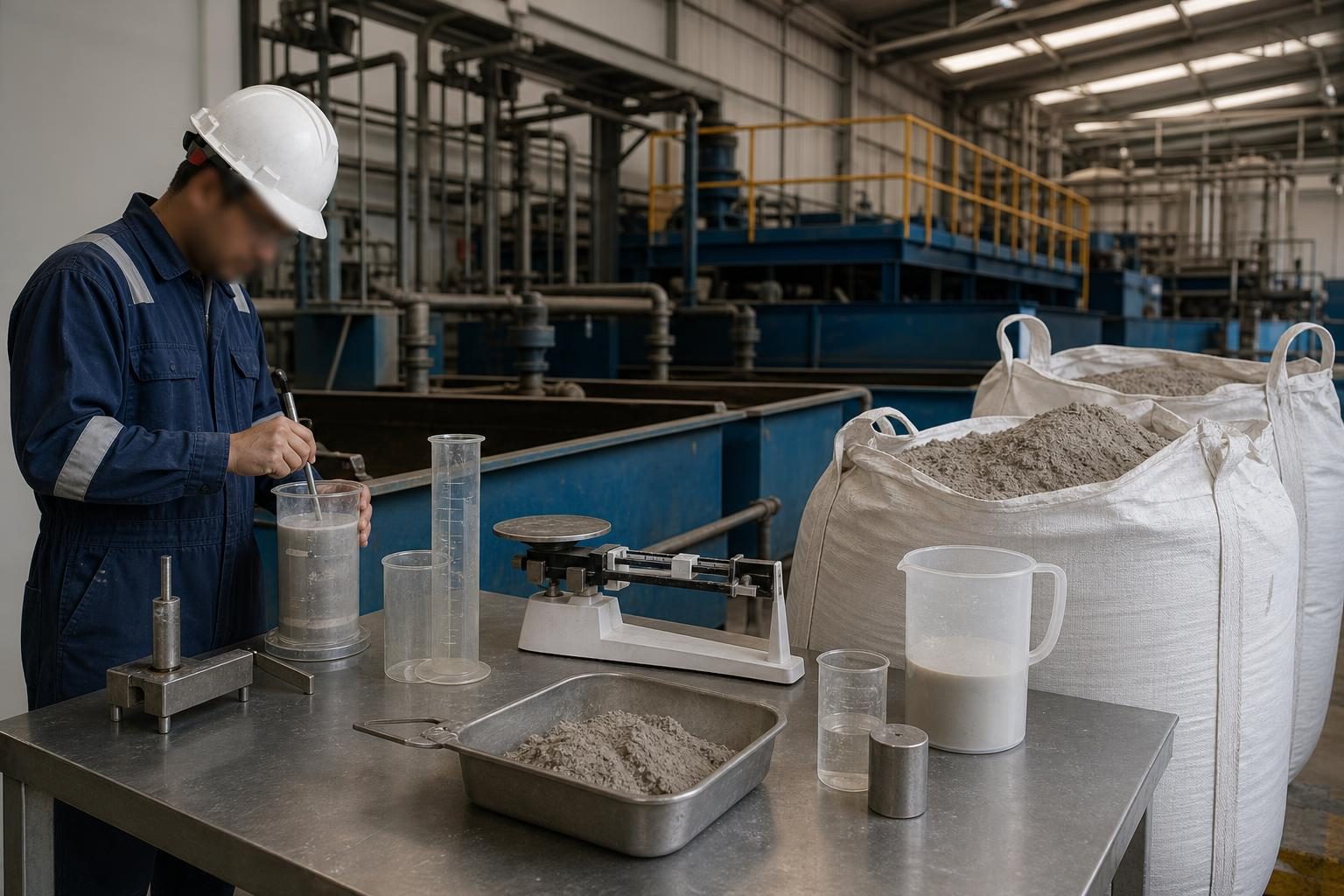
Why specific gravity matters before you order barite
When a mud engineer asks procurement for drilling-grade barite, the buyer often receives two similar-looking options: Barite 4.2 g/mL and Barite 4.1 g/mL. The price difference may be visible immediately, but the tonnage difference is not. Specific gravity controls how much barite is required to reach the target mud weight and how much the active mud volume will increase during weight-up.
This article explains the calculation in buyer language. It is not a substitute for the mud programme or rig-site engineering calculation, but it helps procurement teams check whether an RFQ gives suppliers enough information to quote the correct grade and quantity.
What barite does in drilling fluid
Barite, or barium sulfate, is used as a high-density solid weighting material in drilling fluids. USGS describes barite as being ground to a small, uniform size for use as a weighting agent in petroleum well drilling mud, and its Mineral Commodity Summaries note that typically more than 90% of barite sold in the United States is used in drilling-fluid weighting applications.
In field terms, mud weight is normally discussed in pounds per gallon (ppg), specific gravity, or kg/m3. Higher mud weight increases hydrostatic pressure. The Amoco Drilling Fluids Manual gives the common hydrostatic pressure relationship: hydrostatic pressure in psi equals mud weight in ppg multiplied by true vertical depth in feet multiplied by 0.052. That is why mud weight-up calculations are operationally important, not just commercial arithmetic.
API 13A barite density grades
API Specification 13A Addendum 2 states that drilling-grade barite is produced from commercial barium sulfate ores and gives two density grades: Barite 4.1 g/mL and Barite 4.2 g/mL. The same API document states that, other than density, the two grades have identical test specifications, and it notes that Barite 4.1 g/mL may not be appropriate for higher mud weights without a performance evaluation against Barite 4.2 g/mL.
| API 13A barite requirement | Barite 4.1 g/mL | Barite 4.2 g/mL |
|---|---|---|
| Density | 4.10 g/mL minimum | 4.20 g/mL minimum |
| Water-soluble alkaline earth metals, as calcium | 250 mg/kg maximum | 250 mg/kg maximum |
| Residue greater than 75 µm | 3.0% maximum mass fraction | 3.0% maximum mass fraction |
| Particles less than 6 µm equivalent spherical diameter | 30% maximum mass fraction | 30% maximum mass fraction |
For a commercial enquiry, do not write only “barite powder”. State whether the project requires API 4.2 drilling barite, API 4.1 drilling barite, or another buyer-approved specification. For a grade comparison, buyers can also review Barite API 4.2 vs API 4.1.
The weight-up calculation buyers should understand
For planning purposes where the mud system is allowed to increase in volume, a useful field-unit expression is:
Barite required, lb per initial bbl of mud = 350 × SGb × (MWf − MWi) / (8.33 × SGb − MWf)
Where SGb is the actual barite specific gravity, MWi is initial mud weight in ppg, and MWf is final target mud weight in ppg. The constant 350 is the approximate weight in pounds of one barrel of fresh water. The Amoco manual gives the same material-balance basis for weight-up calculations and states that volume increase in barrels equals total pounds of weighting material divided by 350 multiplied by the weighting-material specific gravity; for 4.20 SG barite this becomes pounds of barite divided by 1470.
For metric planning, using mud densities as specific gravity values:
Barite required, kg per m3 initial mud = 1000 × SGb × (SGf − SGi) / (SGb − SGf)
These formulas assume a simplified material balance. They do not account for fluid loss, dilution water, solids-control losses, oil/water ratio adjustment, chemical additions, barite sag risk, or rig-specific mixing efficiency. The mud engineer should approve the final quantity.
Example: 1,000 bbl from 10.0 ppg to 12.0 ppg
The table below compares the estimated barite addition for a simple volume-increase case. It uses the formula above and assumes the barite actually meets the stated minimum density.
| Input or result | Barite SG 4.20 | Barite SG 4.10 |
|---|---|---|
| Initial mud volume | 1,000 bbl | 1,000 bbl |
| Initial to final mud weight | 10.0 to 12.0 ppg | 10.0 to 12.0 ppg |
| Estimated barite addition | 127.9 lb/bbl initial mud | 129.6 lb/bbl initial mud |
| Total barite | 127,900 lb, about 58.0 metric tonnes | 129,600 lb, about 58.8 metric tonnes |
| Approximate 100 lb sacks | 1,279 sacks | 1,296 sacks |
| Estimated volume increase | 87.0 bbl | 90.3 bbl |
In this moderate example, using 4.10 SG instead of 4.20 SG adds roughly 0.8 metric tonnes and about 3.3 bbl of extra mud volume. At higher target mud weights, the difference becomes more important because the target fluid density moves closer to the density of the weighting material. This is the practical reason API warns that Barite 4.1 may require performance evaluation for higher mud weights.
What to put in the barite specification or RFQ
A precise RFQ helps the supplier quote the correct grade and helps the buyer avoid comparing unlike offers. Include:
- Required standard and grade: API Specification 13A / ISO 13500 Barite 4.2 g/mL or Barite 4.1 g/mL, as approved by the mud programme.
- Target use: water-based mud, oil-based mud or other drilling-fluid system, if the buyer is allowed to disclose it.
- Calculation inputs: initial mud weight, target mud weight, active system volume, and whether volume increase is acceptable.
- Lot documents: request product specification, certificate of analysis, safety data sheet and lot identification. Do not rely on a generic brochure when a specific shipment is being purchased.
- Test parameters: density, soluble alkaline earth metals as calcium, residue greater than 75 µm, and particles less than 6 µm, because these are API barite table requirements.
- Packaging: state required bag size, palletisation or jumbo bag requirement, discharge method and port or site handling limitations. For large mineral deliveries, the buyer can also review bulk minerals in 1.5 ton jumbo bags.
Buying and verification tips
First, ask whether the calculation used the actual tested SG or only the commercial grade name. A product sold as API 4.2 should meet the minimum density requirement, but the buyer should still check the COA for the lot being supplied.
Second, do not evaluate tonnage without checking package net weight and tolerance. API 13A Addendum 2 states that super sacks and bulk bags shall contain a specified net mass within ±5%, and that the average mass of a sampled 5% of the shipment shall not be less than the specified mass. This matters when a purchase order is converted into bag counts.
Third, keep engineering and procurement units consistent. A common error is mixing ppg, SG, kg/m3 and metric tonnes in one spreadsheet without unit conversion. State the formula basis in the RFQ or internal calculation sheet.
Finally, remember that barite quality is lot-specific. General API information tells the buyer what to ask for; it does not prove that a particular supplier’s lot meets the requirement. Buyers can request the product specification, COA, SDS or sample from Kasbonex for the specific lot under discussion.
Frequently Asked Questions
Does lower SG always mean the barite is unsuitable?
No. API 13A recognises both Barite 4.1 g/mL and Barite 4.2 g/mL grades. Suitability depends on the mud weight, drilling-fluid formulation and customer approval. API specifically notes that Barite 4.1 may not be appropriate for higher mud weights without performance evaluation.
Why does 4.1 SG require more tonnes than 4.2 SG?
A lower-density weighting material contributes less mass per unit volume. To reach the same final mud weight, more solid must be added, and the mud volume normally increases slightly more.
Can procurement calculate the final purchase quantity alone?
Procurement can prepare an estimate, but the mud engineer should approve the final tonnage. The engineering calculation must account for rig losses, contingency, dilution, base-fluid additions and actual mud properties.
What document proves the barite SG?
The buyer should request a lot-specific certificate of analysis showing density and the relevant API barite parameters. A generic data sheet is useful for prequalification but should not replace lot verification.
References
- API Specification 13A, 19th Edition, Addendum 2, June 2022
- ISO 13500:2008, Petroleum and natural gas industries — Drilling fluid materials — Specifications and tests
- Amoco Production Company Drilling Fluids Manual
- USGS Mineral Commodity Summaries 2026: Barite
- USGS Minerals Yearbook 2022: Barite
Request barite specifications and a quotation
To discuss drilling-grade barite for a specific enquiry, request technical specifications, a supply-availability check and a quotation by emailing sales@kasbonexglobal.com or via the request form at kasbonexglobal.com. Kasbonex can provide available product documents for the lot under discussion; prices, stock and delivery dates are confirmed only after review of the enquiry details.