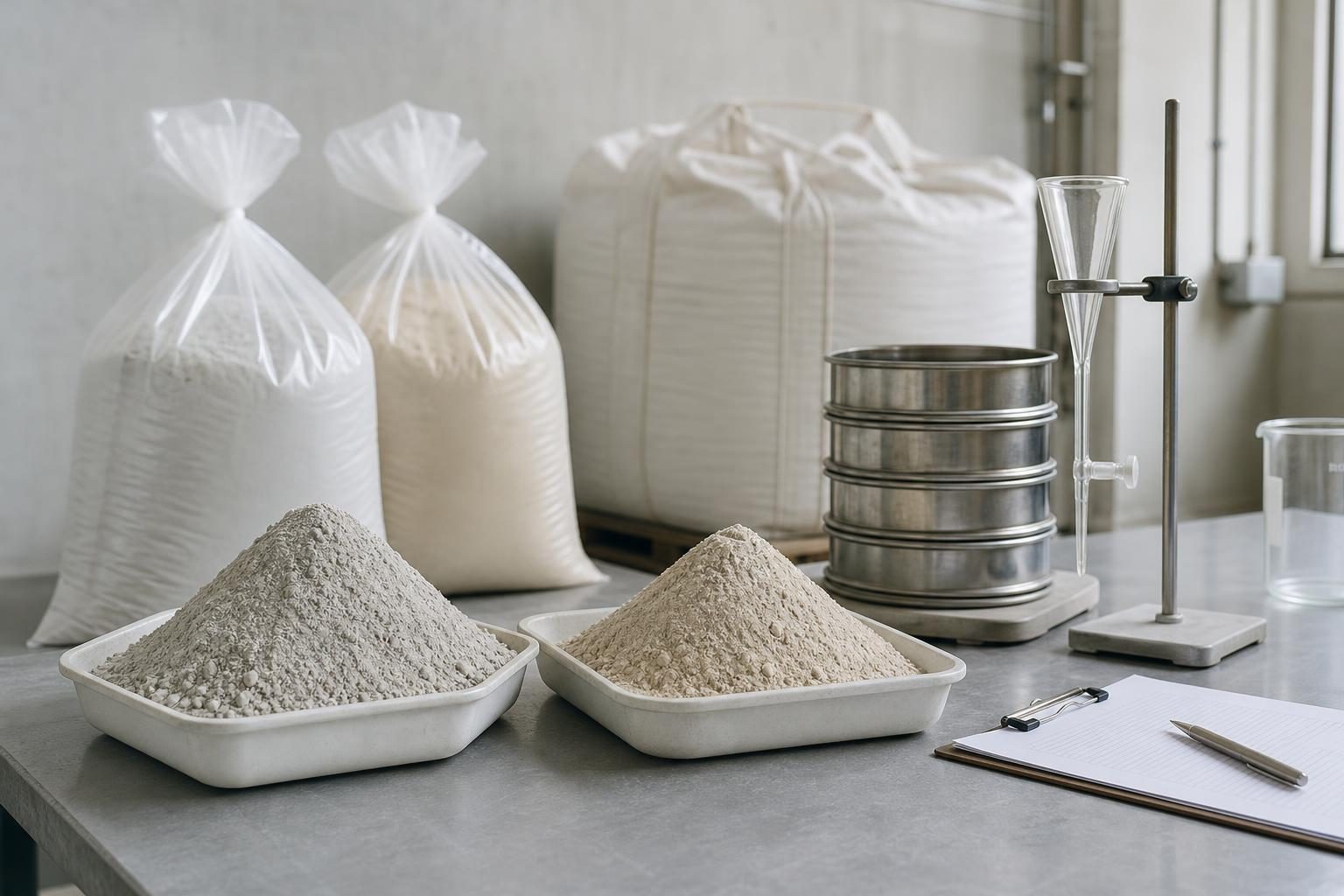
Sodium vs calcium bentonite: the buyer’s practical problem
A bentonite enquiry that only says “bentonite powder” can lead to the wrong offer. Drilling teams may need a high-yield mud material, foundries may need a binder that fits their green-sand system, and civil contractors may need a slurry or sealing material that hydrates reliably in site water. The first question is not only price or origin; it is whether the application needs sodium bentonite, calcium bentonite, sodium-activated bentonite, or a named standard grade.
Bentonite is not a single chemical. USGS describes it as a rock made mainly of smectite clay minerals, most commonly montmorillonite. Its performance is controlled by the dominant clay mineral and exchangeable cations such as sodium or calcium. In practical terms, sodium bentonite is the swelling type, while calcium bentonite is commonly described as lower-swelling or non-swelling compared with sodium bentonite.
For current commercial lots, the buyer should not rely on the name alone. Ask for the product specification, certificate of analysis, safety data sheet and, where the application is sensitive, a representative sample. Kasbonex buyers can review the general bentonite powder range information, but acceptance should be based on the specific lot and the test method agreed in the RFQ.
What changes when the bentonite is sodium or calcium based?
The key difference is hydration behaviour. Sodium montmorillonite disperses and swells strongly in water, which helps create viscosity, gel structure and low-permeability filter cakes. USGS notes that many bentonites can swell to more than ten times their dry volume, and a separate USGS report explains that sodium montmorillonite swells in water to many times its dry volume, while calcium and magnesium montmorillonites are much closer to low-swelling clays in their volume increase.
Calcium bentonite can still be valuable. In foundry sands it may contribute useful bonding behaviour, and in some absorbent, filler or specialty uses high swelling is not the main requirement. However, if the job depends on fast hydration, high viscosity or sealing performance, a calcium-rich material may fail even if the mineral is still called bentonite.
Some commercial products are sodium-activated calcium bentonites. Activation can improve swelling and viscosity, but the result should be judged by test data, not by the label. Ask whether the material is natural sodium bentonite, calcium bentonite or sodium-activated bentonite, and require test results under the standard relevant to your industry.
Application guide: what should you request?
| Application | Typical starting point | What to specify in the enquiry |
|---|---|---|
| Oil and gas drilling fluid | API 13A / ISO 13500 bentonite or OCMA-grade bentonite, as required by the mud programme | Required standard, viscosity or dial-reading criteria, filtrate, residue above 75 microns, moisture, packing and lot COA |
| HDD, piling, diaphragm wall or slurry support | Usually sodium or sodium-activated bentonite, but site water and soil chemistry matter | Marsh viscosity, density, pH, sand content, fluid loss or filter cake requirement, hydration time and project specification |
| Foundry green sand | Sodium, calcium or blended bentonite depending on the foundry sand system | Standard grade if applicable, methylene blue value, swelling index, green compression strength, dry compression strength and LOI |
| Liners, ponds, GCLs and sealing works | Low-permeability sodium bentonite is commonly specified for GCL-type barriers | Hydraulic conductivity target, bentonite mass or content, swell index, moisture, compatibility with site water or leachate |
Drilling: do not ask only for “sodium bentonite”
For drilling-fluid procurement, request the standard grade. ISO 13500 covers physical properties and test procedures for drilling-fluid materials including bentonite, non-treated bentonite and OCMA-grade bentonite. API Spec 13A has the same practical role in many oilfield enquiries and is intended for manufacturers, distributors and end users of named drilling-fluid materials.
Common API and OCMA comparison tables list drilling bentonite tests such as 600 rpm viscometer dial reading, yield point/plastic viscosity ratio, filtrate volume, residue above 75 microns and moisture. A published geological survey bulletin reports API bentonite reference values of 600 rpm dial reading minimum 30, filtrate volume maximum 15.0 cm³, residue above 75 microns maximum 4.0 percent by weight and moisture maximum 10.0 percent. The same table lists OCMA bentonite with 600 rpm dial reading minimum 30, filtrate volume maximum 16.0 cm³, residue above 75 microns maximum 2.5 percent and moisture maximum 13.0 percent.
Because standards can be revised and project specifications can override generic limits, quote the exact edition or client specification in the RFQ. If you are comparing OCMA and API wording, also read the practical guide to OCMA vs API 13A bentonite powder.
Foundry: match the binder to the sand system
Foundry buyers should avoid assuming that sodium is always better. The correct grade depends on casting type, sand grain size, return-sand condition, moisture control and the foundry’s preferred test method. Indian Standard IS 12446:2007, for example, classifies foundry bentonite into sodium-base grades Na 450 and Na 370 and a calcium-base grade Ca 220. Published summaries of the standard list test areas such as fineness, moisture, pH, liquid limit, gel formation index, free swelling capacity, swelling index, methylene blue value, cone fusion temperature and bonding properties.
For a foundry RFQ, state the standard if your quality plan uses one, but also add the performance tests your sand laboratory will run. Useful data include methylene blue value, green compression strength, dry compression strength, wet tensile strength, shatter index, moisture and loss on ignition. If the supplier’s test mixture is different from your foundry sand system, run a sample trial before bulk purchase. The bentonite powder sample evaluation checklist can help structure that review.
Civil works: check site water and slurry properties
For bored piles, diaphragm walls, slurry trenches and HDD, the bentonite type must work with local water and soil. Hard water, saltwater, cement contamination and fine sand loading can change hydration, viscosity and filter cake quality. FHWA’s drilled-shaft manual gives mineral slurry control ranges including density 64.3 to 72 lb/ft³, Marsh funnel viscosity 28 to 50 seconds per quart, pH 8 to 11 and sand content maximum 4.0 percent immediately before concrete placement. It also notes that attapulgite or sepiolite may be preferred over bentonite for salt-water mineral slurry applications.
For diaphragm wall work, EN 1538 summaries list fresh bentonite suspension checks such as density below 1.10 g/cm³, Marsh value 32 to 50 seconds, fluid loss below 30 cm³, pH 7 to 11 and filter cake below 3 mm. These are project-control values for the prepared suspension, not a universal powder specification. Your RFQ should ask the supplier for powder data and should tell the contractor what field slurry properties must be achieved.
What to put in a precise RFQ
- Application: oilfield mud, HDD, piling, diaphragm wall, foundry green sand, liner or other use.
- Type requested: natural sodium, calcium, sodium-activated or named grade under API 13A, ISO 13500, OCMA, IS 12446 or project specification.
- Test limits: list the exact test method and limit, not just “good swelling” or “high viscosity.”
- Water conditions: freshwater, hard water, brackish water, seawater or cement-contaminated environment.
- Documents: current product specification, COA for the lot, SDS, packing details and sample availability.
- Packaging and logistics: bag size, palletising, jumbo bags, container loading preference and destination port or site.
Frequently Asked Questions
Is sodium bentonite always better than calcium bentonite?
No. Sodium bentonite is usually preferred where swelling, viscosity and sealing are the main requirements. Calcium bentonite can be suitable for selected foundry, absorbent or specialty uses, provided the test results match the buyer’s process.
Can calcium bentonite be used for drilling mud?
Only if it meets the required drilling-fluid specification after processing or activation. For oilfield procurement, request API 13A, ISO 13500 or the client’s exact mud-material specification rather than relying on the calcium or sodium label.
Which bentonite should a foundry request?
Request the grade and tests used by your foundry laboratory. Sodium, calcium and blended binders can all appear in foundry work, but acceptance should be based on methylene blue value, swelling, compression strength, moisture and trial performance in your sand system.
What documents should I ask Kasbonex for?
Ask for the product specification, lot COA, SDS, packing details and, when needed, a sample for your laboratory. Availability, test values and documents must be confirmed for the specific lot being offered.
References
- USGS Open-File Report 2005-1294-A, Bentonite overview
- USGS, The relation between composition and swelling in clays
- ISO 13500:2008, drilling fluid materials specifications and tests
- API publications catalog, Spec 13A drilling fluid materials scope
- Geological Survey of Western Australia, Bulletin 20, bentonite drilling-mud specifications table
- IS 12446:2007 public copy, Bentonite for use in foundries
- FHWA GEC10, Drilled Shafts: Construction Procedures and Design Methods
- EN 1538 summary, Execution of diaphragm walls
- EPA-hosted GCL specification example using sodium bentonite and ASTM D5887
Request specifications and a quotation
If you are unsure whether to request sodium, calcium or sodium-activated bentonite, send your application, standard, test limits, water conditions, packing preference and destination details. To request technical specifications, a supply-availability check and a quotation, email sales@kasbonexglobal.com or use the request form at kasbonexglobal.com. Kasbonex will confirm documents and availability for the specific lot; no price, stock or delivery date should be assumed until the offer is issued.